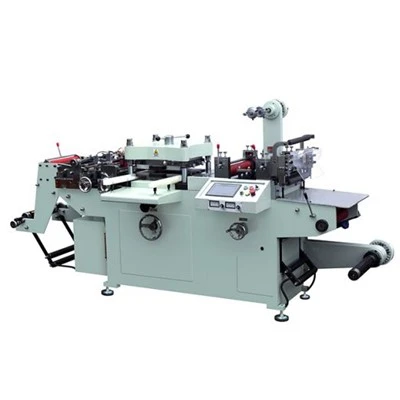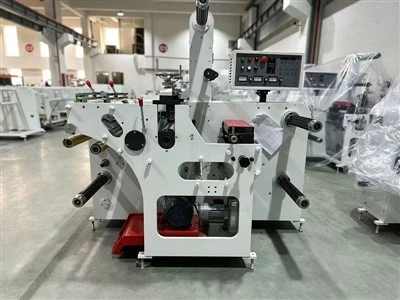


Technical parameter
|
Die cutting repeat length |
206.375-4762.5mm (65tooth¾150tooth) |
|
slitting speed |
120m/min |
|
Die-cutting speed |
100m/min |
|
Max web width |
450mm |
|
Max unwinding diameter |
600mm |
|
Max rewinding diameter |
600mm |
|
Overall diameters(LxWxH) |
1650x1000x1700mm |
|
Machine weight |
650kg |
| Main motor (0.75kw) | 1pc (China) |
| In-phase motor (0.35A 220V) | 1pc (China) |
| Transducer | 1pc (Japan) |
| Electric eye | 1pc (France) |
| Electric eye | 2pcs (China) |
| Blower | 1pc (China) |
| Knife | 10pcs(China) |
| Air shaft | 2pcs (China) |
The machine has three air shaft, two for rewinder (3")and one for unwinder(3"), with Taiwan Sensor for web guide, and one Germany sensor for counting piece.
Picture for reference


Options device


1. Packing: Sea worthy new wooden case
2. Quality Guarantee: all parts should be covered by the factory for free of charge within one- year guarantee date of shipment. If the machine need repair within this period, the seller shall provide technical support. in case problem can not be sole over the phone the buyer will provide transportation and accommodations ask seller coming for repair.
3. Term of trade: FOB NINGBO PORT, CHINA
4. Payment: 50% T/T payment for deposit, the rest 50% T/T payment before shipment.
5. Delivery time: machine shall be sent within 5-10 working days after getting the deposit.
FAQ
Q: What is the accuracy of rotary die cutting?
A: Typical accuracy is:
±0.1 mm to ±0.3 mm depending on machine grade
High-end servo-controlled machines can achieve very stable registration over long runs.
Q: What is the maximum web width the machine can handle?
A: It depends on model, common ranges:
350 mm / 450 mm / 650 mm / 850 mm / 1050 mm / 1300 mm
Custom machines can go wider for industrial applications.
Q: How many slitting knives can be installed?
A: Usually:
10–50 sets depending on machine width
Some high-end models support quick-change slitting systems.
Q: Can the machine support automatic job changeover?
A: Yes, advanced models support:
Recipe memory (job storage)
Automatic tension and register adjustment
Quick die change systems
Q: How long does it take to change a die cylinder?
A: Typical time:
10–30 minutes (experienced operator)
With quick-lock systems, even faster.
Q: What is the difference between magnetic die and solid die?
A: Magnetic die: Flexible, faster change, lower cost for small/medium runs
Solid steel die: More durable, higher precision, suitable for long runs
Q: What materials are not suitable for rotary die cutting?
A: Very thick rigid boards (better for flatbed die cutting)
Highly elastic materials without proper tension control
Extremely soft films without stabilization
Q: What causes register drift during production?
A: Common reasons:
Film stretching due to tension imbalance
Temperature changes affecting material
Sensor misalignment
Encoder or servo calibration issues
Q: Does the machine require air supply or vacuum system?
A: Yes, many machines require:
Compressed air (for pneumatic systems, waste removal, shaft control)
Some advanced systems also use vacuum for waste stripping.
Q: What is waste matrix removal?
A: Waste matrix removal is the process of stripping excess material after die cutting, leaving only the finished labels or shapes.
Q: Can the machine handle perforation or half-cutting?
A: Yes, rotary die cutting machines can perform:
Full cut
Kiss cut (half cut)
Perforation (tear line cutting)
Q: What is kiss cutting?
A: Kiss cutting means cutting only the top layer (label) without cutting the backing liner, commonly used for sticker labels.
Q: What is the lifespan of a rotary die?
A: Depends on usage:
Steel die: 5–10 million impressions or more
Magnetic die: shorter but replaceable surface tooling
Q: What happens if die pressure is too high?
A: Film deformation
Blade wear increases
Cutting burrs or edge damage
Registration instability
Q: What is the role of servo motors in the machine?
A: Servo motors control:
Web feeding
Registration alignment
Cutting synchronization
They improve precision and reduce mechanical error.
Q: Can the machine integrate with printing lines?
A: Yes, it can be:
Inline with flexo printing
Inline with gravure printing
Offline finishing system
Q: What is the typical machine setup time for a new job?
A: Depending on complexity:
Simple job: 15–30 minutes
Complex multi-lane jobs: 30–60 minutes
Q: What is the most common reason for production downtime?
A: Material breakage
Register sensor issues
Die wear or damage
Slitting blade dullness
Tension instability
Q: Can the machine handle transparent films?
A: Yes, but requires:
High-precision sensors
Proper contrast marks or special registration systems
Q: What is the role of edge guiding system?
A: Edge guiding ensures the material stays aligned laterally during running, preventing misalignment in cutting and slitting.
Q: How is finished product rewound?
A: After cutting and slitting:
Multiple rewind shafts collect finished rolls
Each shaft can be independently tension-controlled
Q: What are key factors when choosing a rotary die cutting machine?
A: Web width requirement
Material types
Required speed (m/min)
Register accuracy needs
Slitting configuration
Automation level
Hot Tags: fq450r rotary die cutting machine, China fq450r rotary die cutting machine manufacturers, suppliers, factory, cut out sticker printer, digital label cutter, flatbed label die cutting machine, intermittent rotary die cutting machine, label die cutting machine, label slitting die cutting machine